
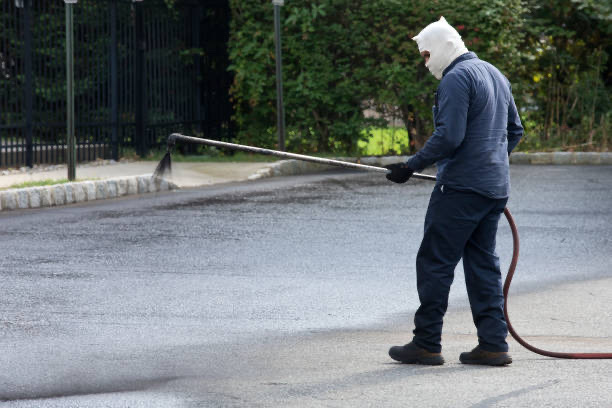
Only hairline cracks. Sealcoat is a thin protective coating, not a structural filler. Poured into an open crack, it shrinks as it dries and leaves the crack open underneath, and winter freeze-thaw cycles reopen it. Wider cracks need to be filled with a proper crack filler before sealing.
Know your cracks
| Crack type | What it usually means | Before sealing |
|---|---|---|
| Hairline surface cracks | Asphalt drying out with age | Seal. The coat covers them. |
| Linear cracks, about 1/4" and wider | Expansion, contraction and edge stress | Fill with crack filler, then seal. |
| Alligator cracking (connected web) | Weak or wet base underneath | Repair the area. Filler won't fix it. |
| Potholes, sinking | Base failure | Patch or rebuild first. |
Cold-pour vs. hot-pour crack filler
Hardware stores sell cold-pour filler in jugs and caulk tubes. Professional crews often use hot-pour rubberized crack sealant, which is melted in a heated kettle and applied hot.
| Cold pour | Hot pour (rubberized) | |
|---|---|---|
| Application | Poured or squeezed from a container | Heated in a kettle, applied hot |
| Flexibility | Limited. Can shrink or pull away. | Stays flexible as asphalt expands and contracts |
| Typical lifespan | Often a season or two | Usually longer, when applied correctly |
| Best for | Small DIY touch-ups | Active cracks through Illinois winters |
Alligator cracking is a base problem
A web of connected cracks means the base under the asphalt is weak, often from water getting in through earlier cracks. Clay soils common in the region hold water, which makes base problems worse. Filling each small crack won't fix it. The area needs to be cut out and repaired, or the driveway resurfaced.
What sealer does for cracks
On a driveway with fine hairline cracking, sealer flows over the cracks, darkens them to match, and slows new ones from forming by keeping water and UV off the surface. That's why sealing early, before cracks open wide, is the best defense.
How cracks grow through a winter
- Rain or melt water runs into an open crack.
- At night it freezes and expands, pushing the crack wider.
- During the day it thaws and more water gets in.
- Water reaches the base, softening it.
- Without support, the asphalt sags and breaks into potholes.
Northern Illinois goes through many of these cycles every winter, and road salt keeps the surface wet longer. That's how a crack you could barely see in October becomes a pothole by March.
A simple crack checklist
- Can you fit a coin into the crack? It needs filling before sealing.
- Is one side lower than the other? Possible base problem.
- Are cracks connected into a web? Repair the area.
- Only thin surface lines? Sealing is the right next step.
Our role
We only do sealcoating. If your driveway needs crack filling or patching first, we'll tell you honestly in your estimate rather than seal over it. Most residential driveway sealcoating projects range from $250–$550. Your final price depends on driveway size, surface condition, preparation, and any additional repairs needed. Request a free estimate for pricing specific to your driveway.