
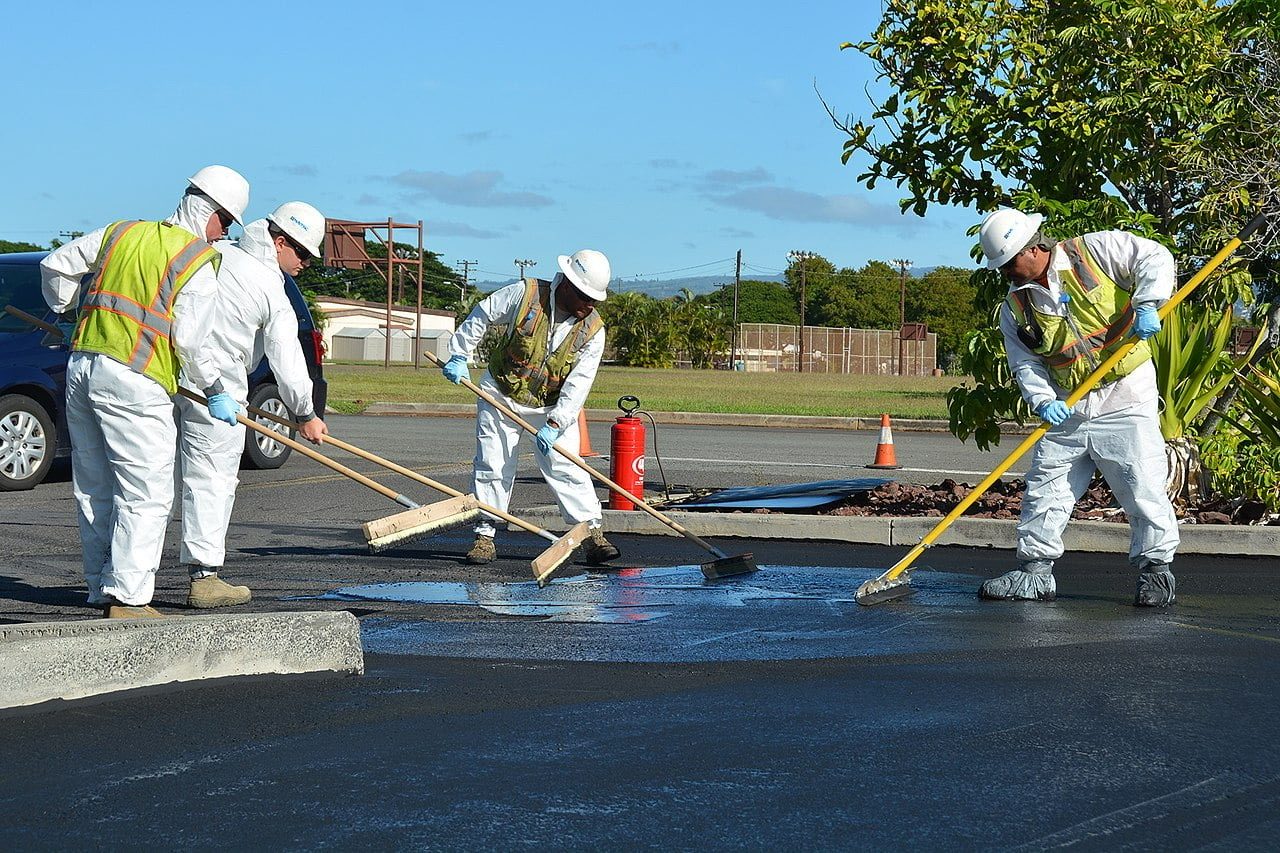
For most residential driveways, squeegee or brush application works sealer into the surface better, especially on porous, weathered asphalt. Spraying is fast and even, and it's common for large areas or a second coat. Whatever the main method, edges along pavers, walls and concrete should be cut in by hand.
How each method works
| Squeegee / brush | Spray | |
|---|---|---|
| How it goes on | Spread and pushed into the surface by hand tools | Atomized through a spray wand or rig |
| Penetration | Works material into pores and small voids | Coats the surface evenly |
| Best for | Porous or weathered asphalt, first coats | Large areas, smooth surfaces, second coats |
| Overspray risk | Low | Higher near walls, pavers and siding |
| Speed | Slower | Faster |
Why porosity matters
An older driveway has an open, rough surface with lots of small voids. Squeegeeing pushes sealer into those voids so the coat bonds and fills the texture. Spraying alone tends to coat the tops of the stones and bridge over the gaps, which can wear through sooner.
Edges and borders
North Shore driveways often run beside brick pavers, stone walls, concrete aprons and landscaping. Sealer stains masonry and is hard to remove. Spraying close to those surfaces is risky, even with shields.
Is spraying bad?
No. In skilled hands, spraying produces a very uniform coat and is widely used. The problem is spray-only work done quickly with no cleaning, no edge work and no attention to nearby surfaces. That's a shortcut, not a method.
What to ask a contractor
- How will you apply the sealer on my driveway, and why?
- How do you handle edges along pavers, walls and concrete?
- Is the surface cleaned and are oil spots treated first?
- How many coats?
Coats and coverage
How much sealer a driveway needs depends on its size and how porous the surface is. A rough, weathered driveway absorbs more than a tight one. Manufacturers publish coverage rates for each product, and following them keeps the coat from being too thin to protect or too thick to cure well. Two thin coats generally wear more evenly than one heavy coat.
What overspray looks like
- Fine black mist on garage doors, siding or brick.
- Dark specks on concrete walkways and aprons.
- Spots on plants and mulch along the edges.
Once sealer cures on masonry or siding, it's very hard to remove. That's why edges and nearby surfaces deserve the most care.
Weather matters for both methods
Whether sprayed or squeegeed, sealer needs dry pavement, temperatures of at least 50°F and rising, and about 24 hours without rain. Wind also matters for spraying, since it carries mist onto nearby surfaces. See the best time to sealcoat.
Our approach
Every sealcoating job includes edging, cleaning and oil spot treatment, with careful edge work along borders. Ask us how sealer will be applied on your driveway when you request an estimate. Most residential driveway sealcoating projects range from $250–$550. Your final price depends on driveway size, surface condition, preparation, and any additional repairs needed. Request a free estimate for pricing specific to your driveway.