
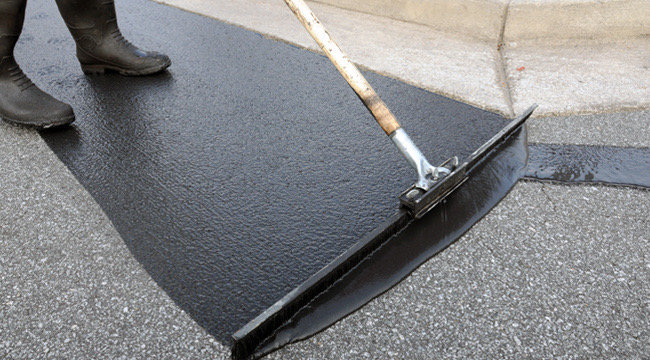
Driveways don't fail overnight. A blacktop driveway gives plenty of warning first, usually for a couple of years before any serious damage shows up. If you know what to look for, you can schedule blacktop driveway sealing at the right time, when it does the most good, and avoid paying for patching or resurfacing later.
All five of these signs are easy to check yourself in a few minutes, no tools needed. Walk your driveway on a dry day, ideally in spring after the snow has melted, and look for each one. If you spot two or more, your driveway is probably ready for sealing.
1. Your driveway has turned gray
New asphalt is black because of the binder, the sticky, tar-like material that holds the stone and sand together. Sun and air slowly oxidize that binder, so the surface fades from black to gray and gets more brittle. If your driveway is noticeably lighter than the street or your neighbor's freshly sealed driveway, the binder near the surface is breaking down.
Graying is the earliest warning sign, and the best time to act. At this stage, the asphalt underneath is usually still sound, so residential driveway sealcoating restores the deep black color and puts a protective layer back on top before the surface starts to come apart. Waiting until the driveway is pale, rough and cracked means more damage and possibly repairs before it can be sealed.
2. You can see loose stone and sand
Small stones and grit collecting on the surface, or piling up along the edges and at the bottom of the slope, mean the binder is wearing away and letting go of the aggregate. This is called raveling. You might also notice the surface feels rougher underfoot, or that little pits are forming where stones have popped out.
Raveling speeds up once it starts, because every lost stone leaves a small hole that holds water. Through an Illinois winter, that water freezes and loosens the stones around it. Sealing at this stage locks the remaining surface together and slows the process down, but the longer it goes, the rougher the driveway will look even after it's sealed.
3. Hairline cracks are appearing
Look along the edges, at the seam where the driveway meets the street and around the garage apron. Thin cracks in those spots are common, because that's where the asphalt flexes most and where water and salt collect. You may also see a crack running down the middle of the driveway where two passes of asphalt meet.
Hairline cracks are a sign the surface is drying out and losing flexibility, and they're a signal to seal soon. A fresh coat covers fine surface cracks along with the rest of the driveway and helps slow new ones from forming. Left alone, water gets into cracks every winter, freezes, and pushes them wider until they branch out or turn into potholes. Wider cracks need repair before sealing, so if yours are past the hairline stage, an honest sealcoating company will tell you in the quote.
4. Oil and gas stains have soaked in
Asphalt is a petroleum product, and other petroleum products like motor oil, gas and transmission fluid soften it. A stain that has soaked into the surface is a soft, weak spot that will break down faster than the rest of the driveway, often turning crumbly right where a car parks every day.
Stains also cause problems for sealer. Sealcoating applied straight over an oil spot often won't bond and can peel off within weeks. That's why oil and gas stains need to be cleaned and treated with a primer before the driveway is sealed. If you have a car that leaks, a drip pan in your usual parking spot helps protect the new coat.
5. Water soaks in instead of running off
Try this: on a dry day, spray part of your driveway with a hose. If the water beads and runs off, the existing coat is still doing its job. If the water darkens the asphalt and disappears into it, the surface has become porous. Water that soaks in now will freeze inside the asphalt this winter.
A porous surface is the clearest sign that the protective layer is gone. It's also the one most directly tied to winter damage, because water in the asphalt is what freeze-thaw cycles act on. A fresh sealcoat fills those pores so water runs off again. If your driveway fails the hose test, it's time to schedule sealing before next winter.
When a driveway might be past sealcoating
Some problems need repair before sealcoating will help: large potholes, alligator cracking (a web of connected cracks across a wide area), and sunken or crumbling sections. If you're seeing those, the driveway needs patching or resurfacing first. An honest driveway sealcoating contractor will tell you that when they quote your driveway rather than sealing over it.